
Dogs Can Smell Cancer Before Your Ultrasound Finds It
New Penn Vet research shows trained dogs detect hemangiosarcoma with 70% accuracy—revealing a disease that has no other early screening test.
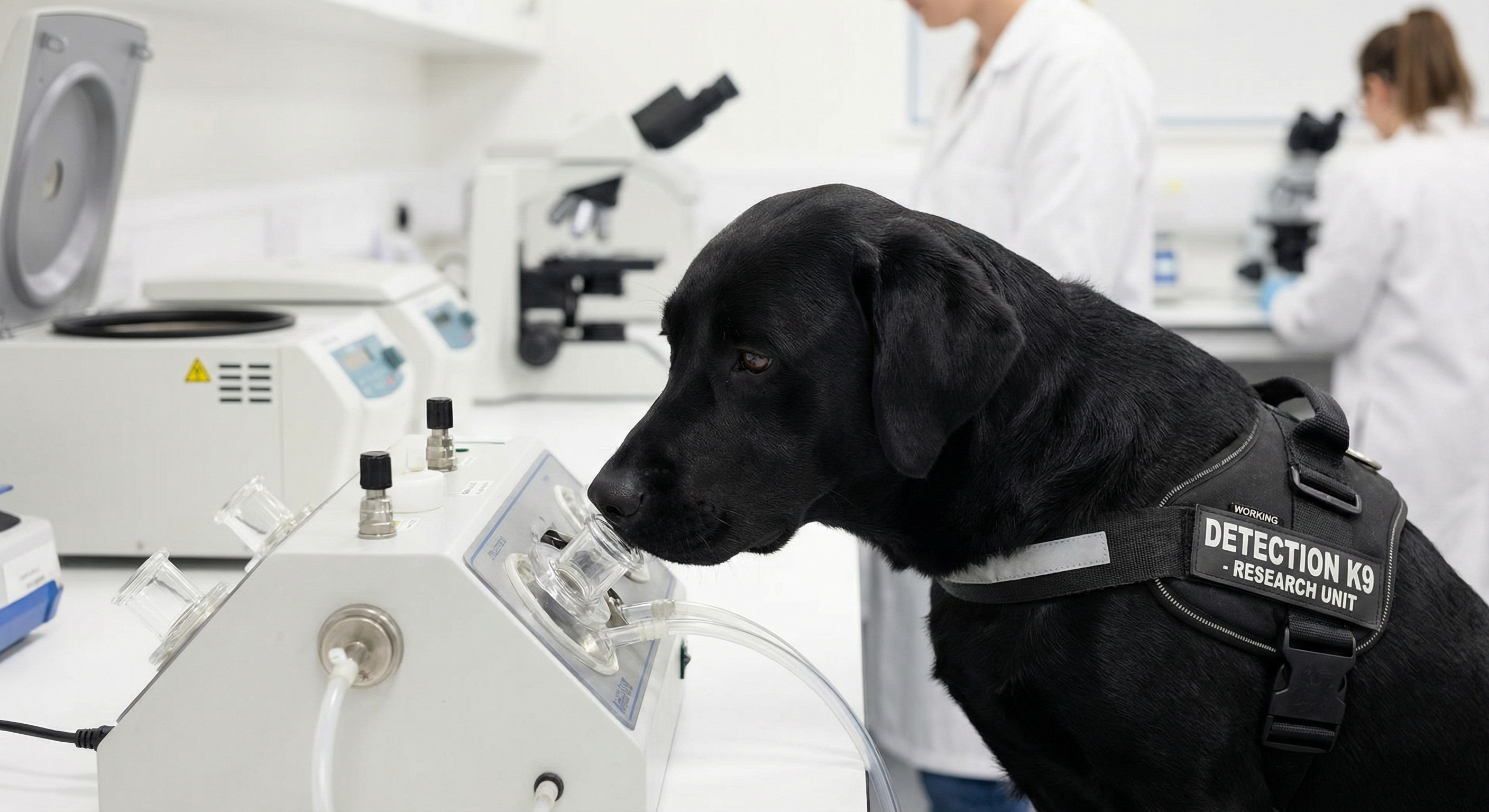
A trained detection dog investigates samples at an olfactometer in a veterinary research laboratory.
We’re Blind to Most of Reality
Here’s a humbling truth: humans perceive almost nothing.
Our eyes detect just 0.0035% of the electromagnetic spectrum. The sliver we call “visible light” is all we get—while radio waves, infrared, ultraviolet, X-rays, and gamma rays wash over us invisibly, every second of every day.
Our ears fare slightly better, but only slightly. We hear sounds between 20 Hz and 20,000 Hz. Elephants communicate in infrasound as low as 5 Hz—rumbles that travel for miles, completely silent to us. Bats and dolphins navigate using ultrasound above 100,000 Hz. We’re deaf to all of it.
And then there’s smell. We have roughly 6 million olfactory receptors. Dogs have 300 million. Their noses are 10,000 to 100,000 times more sensitive than ours. They can detect substances at concentrations of one part per trillion—the equivalent of a single drop in 20 Olympic-sized swimming pools.
This matters because diseases have scents. Cancer cells produce volatile organic compounds (VOCs) as their metabolism goes haywire. These compounds enter the bloodstream, ride through the body, and escape in breath, urine, and blood.
We can’t smell them. Dogs can.
The Silent Killer That Has a Scent
Hemangiosarcoma (HSA) is every dog owner’s nightmare. This aggressive cancer of blood vessel cells earns its nickname—“the silent killer”—honestly. It grows silently in the spleen, heart, or liver. Dogs appear perfectly healthy. Then one day, without warning, the tumor ruptures. Internal bleeding begins. Many owners first learn of the diagnosis during emergency surgery or, worse, during the final goodbye.
There is currently no screening test for hemangiosarcoma. By the time it’s found, it’s usually advanced. Prognosis is poor. Treatment options are limited.
That reality is what drove researchers at the Penn Vet Working Dog Center to ask a simple question: Does hemangiosarcoma have a smell?
The answer, according to research published in The Veterinary Journal (February 2026), is yes.
The Study: 423 Trials, 70% Accuracy
Dr. Cynthia M. Otto, professor of working dog sciences at Penn Vet and executive director of the Working Dog Center, led the study alongside postdoctoral fellow Dr. Clara Wilson and colleagues.
Five trained bio-detection dogs—previously trained to detect diseases including ovarian cancer, pancreatic cancer, PTSD, and chronic wasting disease—participated in double-blinded trials. Using sophisticated devices called olfactometers, dogs sniffed blood serum samples from three groups:
- Dogs with confirmed hemangiosarcoma
- Dogs with non-cancerous diseases (diseased controls)
- Healthy dogs
None of the samples had been used during training. The dogs were encountering them for the first time.
The Results
| Metric | Result |
|---|---|
| Total trials | 423 |
| Overall accuracy | 70% |
| Range by dog | 57.1% – 78.6% |
| Sensitivity | 70% |
| Specificity | 70% |
| Alert rate to HSA samples | 73.4% |
| Alert rate to diseased controls | 21.3% |
| Alert rate to healthy controls | 17.1% |
The statistical significance was striking. Dogs were 10 times more likely to alert to hemangiosarcoma than to diseased controls (OR = 10.2, p < .001) and 13 times more likely than to healthy controls (OR = 13.3, p < .001).
“There’s really no chance that could have happened by accident,” Wilson told The Daily Pennsylvanian. “This means that there must be a smell.”
How an Olfactometer Works
The research used specialized equipment to ensure scientific rigor.
“These machines use an infrared laser beam across the top,” Wilson explained. “When the dog breaks the beam, it registers that the dog is investigating the sample. If they remain in the beam long enough—and it’s the correct sample—they hear a tone and know they have earned a reward.”
This setup allowed researchers to precisely measure accuracy and consistency across hundreds of trials while maintaining double-blind protocols. Neither the dogs nor the handlers knew which samples contained cancer.
“It Really Does Feel Like Magic”
In a January 2026 CBS Philadelphia segment, Wilson described watching the dogs work:
“It really does feel like magic because I can’t smell anything from the samples. It’s a tiny drop of blood serum. Dogs are very unique because they have this incredible sense of smell. It just really does feel amazing and gives me a lot of respect for understanding that there’s a lot of things that I can’t understand that they’re picking up on.”
The volatiles dogs detect are called volatile organic compounds (VOCs)—the actual molecules responsible for what we perceive as “smells.”
“We’re picking up on volatile organic compounds every time we smell something,” Wilson noted. “The dogs have an ability to detect them at much lower levels than we can. These compounds are important because they seem to be the key to how dogs are able to smell things like cancer.”
From Dog Nose to Diagnostic Tool
The long-term goal isn’t to put trained dogs in every veterinary clinic. Instead, researchers hope to identify the specific chemical signature that dogs are detecting—then build a machine that can replicate it.
“We don’t know exactly what the chemical signature is yet,” Wilson acknowledged. “The other difficulty is that we’re constrained by what the machines can do. The dogs are picking up on potentially thousands of chemicals, but a lot of the machines will only pick up on some really strong ones.”
Penn engineers are working on this challenge. The vision: an “electronic nose” blood test that could be performed during routine wellness visits.
“The huge benefit is that it would be a high-throughput option,” Wilson said. “Realistically, we could have a blood test machine in every vet clinic.”
Why Early Detection Changes Everything
If hemangiosarcoma could be caught before symptoms appear, outcomes could improve dramatically.
“If we could identify it before a tumor ruptures, we could intervene sooner,” Dr. Otto explained. “That might mean removing the spleen before catastrophic bleeding occurs or starting chemotherapy earlier. It is the spread of this disease that is so devastating.”
Early detection would also enable something currently impossible: clinical trials testing new treatments in earlier-stage patients.
“This is an initial kernel of hope,” Wilson said.
The Bigger Picture: What Else Are We Missing?
This study joins a growing body of research showing dogs can detect:
- Ovarian cancer in humans
- Pancreatic cancer in humans
- Lung cancer via breath samples
- COVID-19 infection
- Malaria
- Low blood sugar in diabetic patients
- Impending seizures in epileptic patients
- PTSD-related stress via sweat
Each of these conditions produces its own unique VOC profile—a scent fingerprint invisible to us but clear as day to a trained dog’s nose.
We’ve spent centuries building machines to extend our vision: telescopes, microscopes, X-rays, MRIs. We’ve built devices to extend our hearing: ultrasound monitors, radio receivers. But extending our sense of smell? We’re just getting started.
And sometimes the best technology is 15,000 years old, wags its tail, and works for treats.
Key Takeaways for Veterinarians
-
Hemangiosarcoma produces a detectable odor in blood serum—a finding that could enable future screening tools.
-
70% accuracy in a proof-of-concept study is promising, matching rates seen in studies of dogs detecting human cancers.
-
No current screening exists for HSA. Any future blood-based test would be the first of its kind.
-
Electronic nose technology is in development at Penn but not yet ready for clinical use.
-
Watch this space. Penn’s new $94 million Veterinary Diagnostic Laboratory (construction begins fall 2026) may accelerate this work.
External Source Links (Compliance)
References
-
Wilson C, et al. Trained dogs can detect the odor of hemangiosarcoma in canine blood samples. The Veterinary Journal. 2026 Feb;315:106522. doi: 10.1016/j.tvjl.2025.106522. PMID: 41319895.
-
Penn Today. “Sniffing out cancer: Trained dogs can detect hemangiosarcoma by scent.” January 2026.
-
CBS Philadelphia. “Philadelphia researchers train dogs to detect ‘silent killer’ canine cancer.” January 30, 2026.
-
The Daily Pennsylvanian. “Penn Vet study reveals trained dogs can detect canine cancer.” January 27, 2026.
-
Understanding Animal Research. “The science of sniffs: disease smelling dogs.”
-
Kokocińska-Kusiak A, et al. Canine Olfaction: Physiology, Behavior, and Possibilities for Practical Applications. Animals. 2021;11(8):2463. PMCID: PMC8388720.
Sharpen your diagnostic skills with RACE-approved CE from VetOnIt.
Register for Neurology In A Nutshell — Feb 21, 2026 (4 Hr CE) →
Presented by Dr. Susan Arnold. Early detection starts with knowing what to look for.